

SIM-Based 4G CCTV vs Wi-Fi: Best Setup for Remote Sites
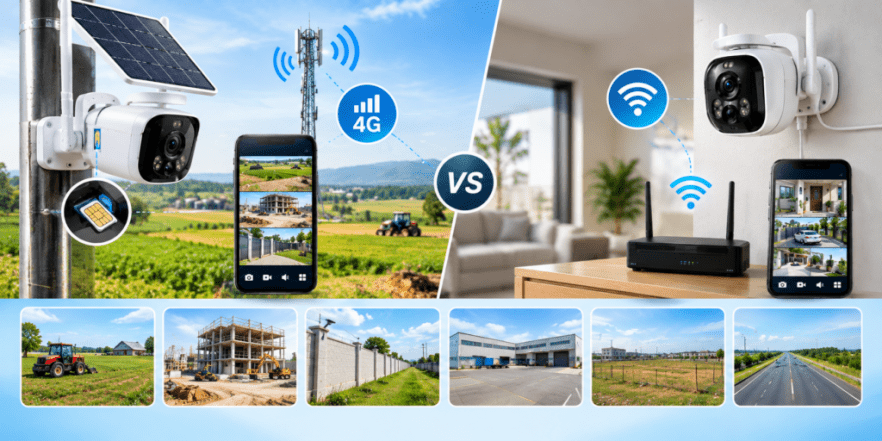
Not every property has the luxury of a stable broadband connection. Farms, construction sites, warehouses on the outskirts of town, and long stretches of boundary wall can sit far beyond a practical Wi-Fi setup. That does not mean CCTV has to be ruled out. Can CCTV work without Wi-Fi? Yes. SIM-based 4G cameras provide an alternative by connecting directly to a cellular network through mobile data. Instead of depending on a Wi-Fi router at the property, the camera uses a compatible SIM card and mobile network to send footage and support remote monitoring.
This guide compares SIM-based 4G CCTV with Wi-Fi setups and explains which option makes more sense for a site with no broadband nearby.
How Does SIM-Based CCTV Work?
A 4G security camera has a SIM card slot and uses a compatible SIM to connect to a mobile data network instead of a home or office router. Depending on the model, footage can be stored locally on a memory card, uploaded to cloud storage, or handled through another supported recording system.
Battery- and solar-powered models can be installed in locations without a nearby electrical connection, provided the site has suitable cellular coverage, and the camera’s environmental requirements are met. No cabling to a router is required, which makes this setup ideal for locations far from existing infrastructure.
Does 4G CCTV Need Broadband?
No, and that is the entire point of a SIM-based setup. A 4G camera pulls its connection from the mobile network using a data plan, completely separate from any home or office broadband line. That makes it a genuinely useful option for a farmhouse boundary, a plot under construction, or a warehouse yard where no internet line has been installed yet.
The main connectivity requirements are a usable mobile signal at the mounting point, along with an active SIM card and a data plan sized to the camera’s expected usage, particularly if it streams live video frequently rather than recording locally.
4G CCTV vs Wi-Fi Camera: Key Differences
The comparisons usually come down to three things: where the site is located, how reliable the existing internet connection is, and what the running costs look like month to month.
| Factor | Wi-Fi Camera | 4G SIM-Based Camera |
| Connection | Home or office router. | Mobile network via SIM card. |
| Best suited to | Properties with existing broadband. | Farms, remote plots, construction sites. |
| Running cost | Usually part of the home internet plan. | Requires a separate mobile data plan. |
| Power options | Wired or battery. | Battery, solar, or wired power depending on model |
| Setup effort | Needs router range and Wi-Fi password. | Needs mobile signal and an active SIM. |
Setting up a 4G camera at a remote site usually calls for a few extras beyond the camera itself. Orient CCTV also offers security camera accessories that can help support remote and off-grid installations.
Best CCTV for Remote Areas without Internet: Ideal Locations for 4G Cameras
For remote areas without broadband, a 4G camera with reliable cellular coverage can be a practical option. Battery- or solar-powered models are especially useful when electrical power is also unavailable. Certain property types clearly benefit from this kind of system.
SIM-based cameras are the most suitable for these locations:
· Farms and Agricultural Land
Large open land rarely has broadband reaching every corner. A solar-powered 4G camera watching a gate or storage shed needs suitable cellular coverage and sufficient solar power to stay connected.
· Construction Sites under Development
A site under construction has no fixed internet yet, and a temporary broadband or wired connection may not be practical or cost-effective for a short-term site. A 4G camera provides coverage from day one without waiting on infrastructure.
· Boundary Walls and Perimeter Fencing
A long perimeter wall often sits well beyond router range. Battery-powered 4G units can be placed at suitable points along the boundary without network cabling, provided each location has adequate cellular coverage.
· Warehouses in Industrial Zones
Some industrial areas have patchy or unreliable broadband. A 4G camera can serve as a backup connection, or even the primary connection, when local broadband is unavailable or unreliable.
· Vacant Plots and Under-Construction Homes
An empty plot with building materials on site is a common target for theft. A solar 4G camera can monitor the property long before you install any utility connection.
· Roadside or Highway-Facing Properties
Properties facing a highway or a rural road often sit outside broadband coverage entirely. Properties facing rural roads or highways may have limited broadband options while still having usable cellular coverage, making 4G cameras worth considering.
When a Wi-Fi Setup Still Makes More Sense
A 4G camera is not automatically the better choice everywhere. For a house, shop, or office that already has a stable broadband connection, a Wi-Fi camera is usually cheaper to run month to month, since it doesn’t require a separate data plan. A Wi-Fi camera may be better suited to continuous high-resolution streaming when it has a strong connection to a reliable broadband service. A 4G connection can also support video streaming, but performance depends heavily on cellular coverage, network congestion, and the camera’s bitrate and resolution.
If the property sits within easy reach of an existing router and the signal is consistently strong, sticking with Wi-Fi keeps the setup simpler and the running cost lower. The decision really comes down to two questions: does broadband already reach the mounting point, and is the mobile signal there strong enough to rely on?
Frequently Asked Questions
1. Can CCTV work without Wi-Fi at all?
Yes. A 4G SIM-based camera can connect through the mobile network instead of Wi-Fi, so it can operate at locations without a router or broadband connection, provided there is compatible cellular coverage.
2. Do I need a special SIM card for a 4G security camera?
Many 4G cameras use a SIM card with a mobile data plan, but the supported SIM size, carriers, and network bands vary by model. Check the manufacturer’s specifications before choosing a SIM.
3. Is a 4G camera slower than a Wi-Fi camera?
It depends on the mobile signal strength at the site. It depends on the quality of both connections. A strong 4G connection can provide smooth remote viewing, while weak coverage or network congestion can cause buffering or delays. A Wi-Fi camera can also perform poorly if the router connection or broadband service is weak.
4. How much data does a 4G CCTV camera use per month?
Usage varies with resolution, bitrate, streaming frequency, cloud uploads, and recording mode, but a camera set to record locally and only alert on motion typically uses far less data than one left streaming live video constantly.
5. Can a 4G camera run entirely on solar power?
Many battery-powered 4G cameras can be paired with a compatible solar panel, making them practical for sites without a nearby electrical connection. Actual performance depends on sunlight, battery capacity, camera power consumption, and recording settings.
Final Thoughts
Choosing between SIM-based 4G CCTV and a Wi-Fi setup comes down to what already reaches your property. A farm, construction site, or boundary wall without broadband can be a good candidate for a 4G camera, particularly when cellular coverage is available and running network cabling or installing broadband is impractical.
Look at what infrastructure your site already has, match the camera to that reality, and you will end up with a setup that actually stays connected instead of one that only looks good on paper.
Planning a camera for a remote site? Orient CCTV supplies a reliable range of CCTV cameras in Pakistan, including 4G and solar-ready models built for locations without broadband.

Lets's Get Social
We are a dedicated professional company that deliver high-quality cameras all over Pakistan


Shariq Tahir
Share On
Related Post
